



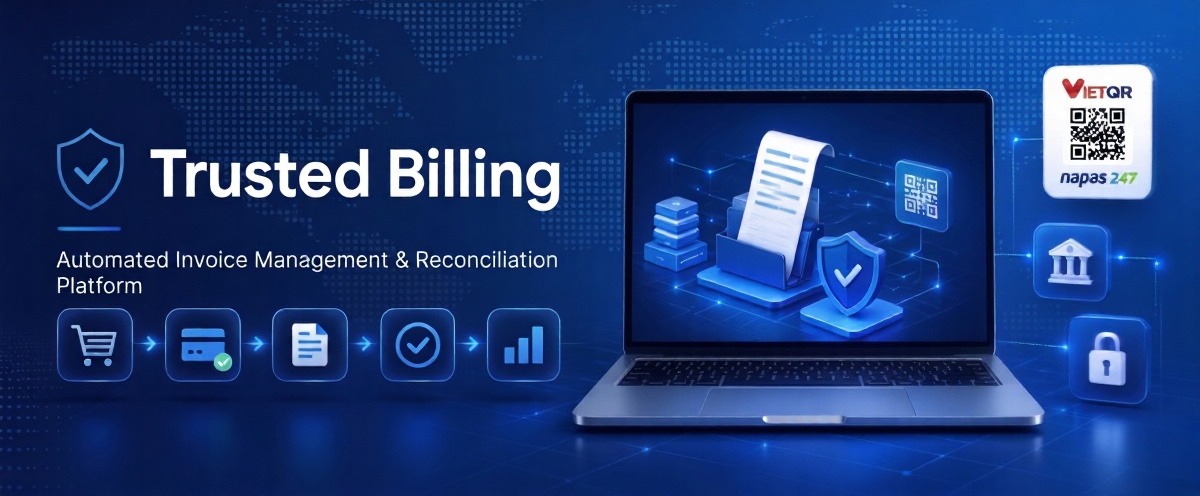
Trusted Billing is Mobile-ID’s SaaS billing platform that brings together Open Banking, VietQR/NAPAS247, virtual accounts (VA), e-Invoice management, and accounting software integration for tax authority reporting. Built for enterprises with professional sales systems that require controlled integration, real-time cash flow monitoring, and compliance-driven operations.
From Fragmented Invoice Management to a Unified Revenue Operating System
Many businesses have ERP, accounting software, and e-invoice platforms operating in silos — orders generated in one place, payments received in another, invoices managed elsewhere, and reconciliation done manually in Excel. Trusted Billing connects all these components into a closed-loop operational chain, reducing manual effort and improving accuracy.
End-to-End Invoice Lifecycle Automation
From bill creation and payment notifications to payment confirmation, e-invoice issuance, and accounts receivable status updates.
Clear, Testable Integration
Provides APIs and connectors for ERP, CRM, POS, accounting systems, subscription platforms, and sales channels.
Regulatory-Compliant Operations
Routes e-invoice flows through certified providers and supports reporting in accordance with tax authority requirements.
Critical Pain Points for Enterprises with Professional Sales Systems
1. Matching Orders – Payments – Invoices
- Each bill has a unique identifier linking it to an order, customer, contract, and billing period.
- Every bank transaction is automatically matched using billRef, QR metadata, VA, or OpenBanking callbacks.
- Invoice status is managed through a defined lifecycle: draft, issued, reported, adjusted, and cancelled.
2. Revenue and Receivables Management
- Real-time dashboard for revenue, outstanding balances, overdue amounts, and reconciliation rates.
- Aging reports by customer, branch, point of sale, sales representative, or product line.
- Full audit log for all bill creation/modification, invoice issuance, payment recording, and refund/adjustment actions.
Proposed Architecture for Trusted Billing
Trusted Billing is built on a microservices, multi-tenant SaaS architecture, supporting connections to enterprise sales systems, banking payment channels, and e-invoice platforms through dedicated adapters.
Closed-Loop Flow: From Order to Invoice and Reconciliation
Order Creation / Billing Period Trigger
ERP/CRM/POS calls the Trusted Billing API to create a bill. The Billing Engine applies pricing tables, taxes, discounts, service fees, due dates, and e-invoice conditions.
Generate Identified Payment Request
The platform generates a billRef, dynamic QR code, virtual account (VA), or payment link. Payment details are sent to the customer via Email, SMS, Zalo, portal, or webhook back to the enterprise system.
Customer Makes Payment
The customer pays via VietQR, VA, NAPAS247, or an Open Banking channel as configured. Transaction content is standardized to support automated reconciliation.
Callback from Bank / Payment Provider
The adapter receives the callback; the Reconciliation Engine verifies the amount, billRef, payer details, VA, and transaction timestamp to determine match status.
e-Invoice Issuance
The Invoice Orchestrator calls the e-Invoice Adapter to generate a compliant invoice, apply digital signature, assign a tax code, and report to the tax authority.
Dashboard Update and Webhook to Enterprise System
The Merchant Portal displays paid / issued / reconciled status. The sales system receives a webhook to close the order, activate services, and record revenue.
Integration Principles for ERP, POS, and Accounting Systems
An API-first approach gives businesses clear, testable, auditable, and incrementally scalable integrations.
| API Group | Purpose | Example Endpoint | Technical Controls |
|---|---|---|---|
| Bill API | Create, update, and cancel bills; link to orders, contracts, and customers. |
POST /api/v1/billsGET /api/v1/bills/{billId}
|
Idempotency-Key, tenantId, unique billRef, amount validation. |
| Payment API | Generate QR/VA/payment links and query transaction status. |
POST /api/v1/payments/intentsGET /api/v1/payments/{paymentId}
|
Digital signature, callback URL, bank channel, expiration time. |
| Invoice API | Issue, adjust, replace, and cancel e-invoices. |
POST /api/v1/invoices/issuePOST /api/v1/invoices/{id}/adjust
|
Tax ID, buyer information, VAT lines, invoice template, e-Invoice provider mapping. |
| Reconciliation API | Query match results, handle exceptions, and confirm manual resolutions. |
GET /api/v1/reconciliation/jobs/{id}POST /api/v1/reconciliation/exceptions/{id}/resolve
|
Confidence score, partial payments, overpayments, duplicate transactions. |
| Webhook / Events | Push event notifications to enterprise systems (e.g., bill.paid, invoice.issued). |
bill.paidinvoice.issuedpayment.failed
|
HMAC signature, retry policy, eventId, timestamp, replay protection. |
{
  "event": "bill.paid",
  "eventId": "evt_20260417_000238",
  "tenantId": "merchant_001",
  "billId": "bill_874231",
  "billRef": "TB-INV-2026-000128",
  "amount": 1250000,
  "currency": "VND",
  "payment": {
    "channel": "OPEN_BANKING_VA",
    "bankCode": "BANK_CODE",
    "transactionId": "txn_928173",
    "paidAt": "2026-04-17T09:15:22+07:00"
  },
  "reconciliation": {
    "status": "MATCHED",
    "confidenceScore": 0.99
  },
  "signature": "HMAC-SHA256..."
}
Essential Capabilities for Large-Scale Enterprise Operations
Tenant-Level Data Isolation
Each business has its own bank configuration, invoice settings, document templates, API keys, callback URLs, role-based access, and reporting.
Bank-Grade Security Standards
TLS 1.3, OAuth2/OIDC, mTLS for sensitive APIs, HMAC for webhooks, RBAC, FIDO2/MFA, and immutable audit logs.
24/7 Operational Monitoring
Track callback status, invoice issuance latency, provider errors, settlement delays, and per-tenant SLA performance.
Invoice Data Standardization
Validate tax IDs, buyer information, line items, tax rates, discounts, fees, and e-invoice issuance conditions.
Reconciliation Exception Workflow
Handles underpayments, overpayments, duplicate payments, mismatched references, wrong accounts, refunds, and invoice adjustments.
Scale with Transaction Volume
Event-driven architecture handles millions of bills, callbacks, and webhooks with retry logic, dead-letter queues, and horizontal scaling.
Phased Deployment Plan
| Phase | Scope | Outcome | Business Value |
|---|---|---|---|
| Phase 1 | Bill API, Merchant Portal, QR/payment links, paid/unpaid status. | Business can create bills and receive identified payments. | Reduces manual effort and accelerates collections. |
| Phase 2 | OpenBanking callbacks, VA, Reconciliation Engine, webhooks to ERP/POS. | Automated real-time reconciliation. | Fewer errors, faster order closing, and improved receivables management. |
| Phase 3 | e-Invoice Adapter, invoice issuance, tax data mapping. | Payments and invoices synchronized within the same transaction lifecycle. | Improved compliance and reduced dependence on manual accounting tasks. |
| Phase 4 | Advanced analytics, aging reports, automated dunning, multi-branch dashboard. | Full visibility into revenue, receivables, and collection performance across the organization. | Faster decision-making and transparent cash flow management. |
Who Trusted Billing Is Built For
Multi-Location Retail Chains
Store chains, mini supermarkets, and distribution agents that need to reconcile revenue by location and shift.
SaaS / Subscription Businesses
Recurring billing services that require automated bill generation, payment reminders, service renewals, and post-payment invoice issuance.
Logistics, Education, Healthcare, Insurance
Industries with high volumes of receivables, multiple payment channels, diverse document types, and strict receivables control requirements.
Trusted Billing – Unify Cash Flow, Invoicing, and Compliance in One Platform
With an API-first approach, event-driven architecture, and multi-tenant SaaS model, Trusted Billing helps businesses digitize the entire revenue lifecycle — from sales to payment, e-invoice issuance, tax reporting, and automated reconciliation.
Learn More About Trusted Billing



Community Discussion
Comments
Comments