
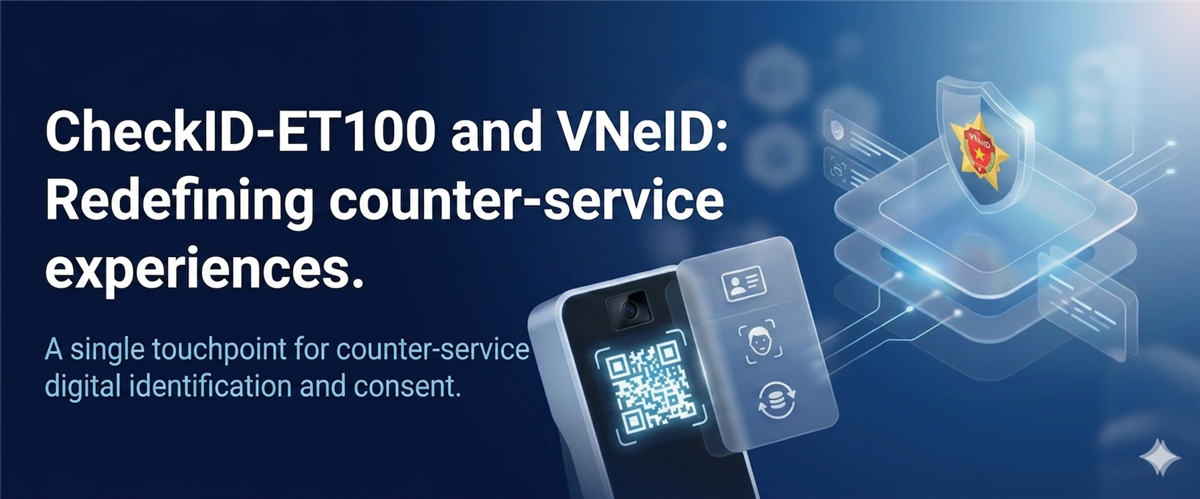
CheckID ET100 and VNeID – Unifying Identity, Consent, and Digital Trust Experience at the Transaction Counter

Publish date:

Digital Identity • VNeID • Digital Transaction Counter

A practical implementation model that integrates CCCD card reading, facial authentication support, QR code display, and Level 2 VNeID consent orchestration into a single, unified, transparent, and controllable transaction journey.

Technical Blog Mobile-ID style Presentation Presales / Marketing

Why This Topic Deserves Immediate Attention

At many transaction points today, identity verification, card reading, facial authentication, QR code presentation, and data-sharing consent processes are still performed in a fragmented manner. This leads to prolonged processing times, inconsistent user experiences, and increased complexity in process control when scaling up.

The proposed CheckID-ET100 solution offers a different approach to re-architecting the service counter as a unified digital interaction point. In this model, the counter device is no longer just supplementary hardware — it becomes the central display and orchestration interface that coordinates with the backend workstation to guide citizens through a seamless digital identity and consent journey.

The real value lies not in adding another device, but in standardizing the entire digital trust experience at the physical counter.
3
Priority Use Cases
Banking, e-Government services, and notarization are the most prominent deployment scenarios.
1
Unified Touchpoint
CCCD reading, QR display, user guidance, and real-time status feedback within a single transaction flow.
2
Trust Foundation
Counter device support combined with electronic consent via Level 2 VNeID.
4
Implementation Phases
Requirements clarification, technical design, controlled pilot, and scalable rollout evaluation.

From Fragmented Processes to a Unified Citizen Journey

The greatest strength of this approach is simplifying operations without compromising control. Instead of dispersing identity verification, authentication, and consent across multiple disconnected touchpoints, the digital service counter model consolidates the citizen-facing experience into a clear, guided flow, while backend integration and authentication remain anchored to official national infrastructure.

Counter Interaction Device CheckID-ET100 serves as the primary display and interaction point for QR codes, user guidance, CCCD reading, and transaction status feedback.
Orchestration with Backend Workstation The workstation can initiate sessions, drive business logic, and synchronize with what the citizen sees on the counter device.
Consent via Level 2 VNeID Citizens perform consent on Level 2 VNeID, increasing trust in the process and aligning with national digital identity infrastructure.
Auditability and Reconciliation The business flow can be designed to generate comprehensive logs, maintain transaction states, and support post-transaction auditing and reconciliation.

Reference Architecture: Practical, Controllable, and Scalable

Architecturally, the solution is organized into coordinated layers: the counter layer (CheckID-ET100 + workstation), the integration and consent orchestration middleware layer, the electronic authentication layer connected to state management authorities and VNeID, and the application layer serving banking, government, or notarization workflows.

A notable aspect of this approach is its strong emphasis on core principles such as purpose limitation, authorized access, transparent consent, data minimization, and privacy-by-design. As a result, it is not merely a UI improvement, but a robust, long-term foundation for digital trust operations at physical counters.
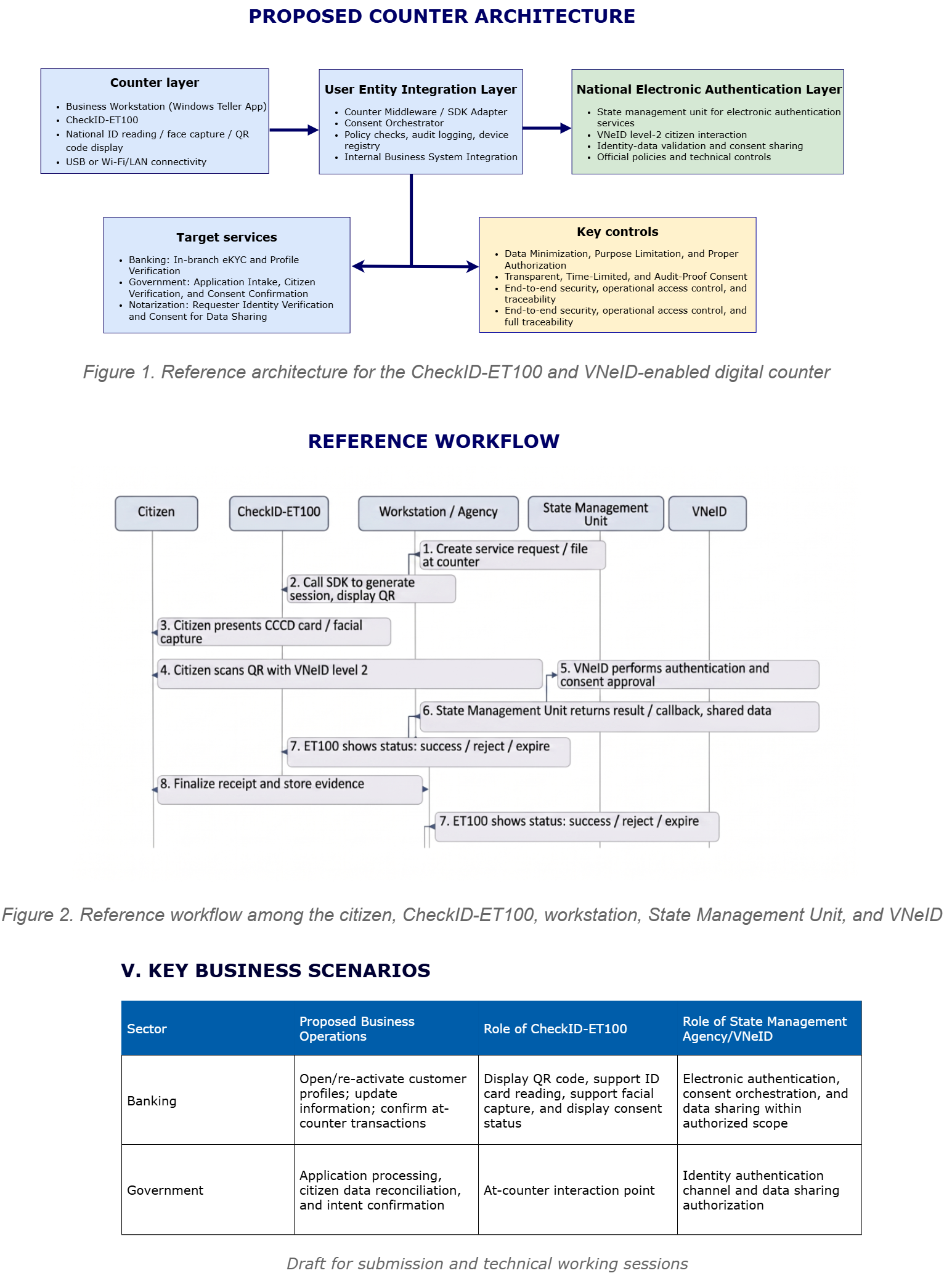
CheckID-ET100 and VNeID Reference Architecture
Illustration extracted from the proposal document: The upper section shows the digital service counter architecture, while the lower section describes the coordinated flow between the citizen, CheckID-ET100, workstation, state management authority, and VNeID.

Immediate Value-Creation Scenarios

Banking and Financial Services

Ideal for high-assurance processes such as account onboarding, digital identity updates, customer verification at counter, and supervised digital consent collection.

e-Government Services

Supports document intake points where identity verification, transparent explanation of data usage purposes, and active citizen consent are all required.

Notarization and Legal Services

Particularly suitable for face-to-face transactions where strict identity verification, expression of intent, and evidentiary record-keeping are essential.

CCCD Reading Facial Authentication Support QR-based Consent Real-time Status Tracking Audit-ready Logging

Governance and Security at the Core

One of the document’s strengths is its cautious and responsible approach. All information regarding APIs, callbacks, shared data, and consent mechanisms must strictly adhere to the scope permitted by competent authorities. This is essential for moving from a pilot concept to actual production deployment.

In terms of implementation, the system must clearly define requirements such as device registration, software and firmware inventory, transaction officer operation logs, temporary data management, and periodic review mechanisms before expanding the deployment scope. In other words, security is not an afterthought — it must be embedded in the design from the very beginning.

Security by Design Data must be controlled from session initiation, transmission, display, through to logging, in accordance with roles and authorized purposes.
Data Minimization Only process and retain information that is strictly necessary, within the approved legal and operational scope.
Transparent Consent Citizen consent steps must be clear, understandable, time-bound, and support review and withdrawal where applicable.
Clear Operational Accountability Every layer — from devices and workstations to middleware and operation logs — must have transparent governance responsibilities.

Pragmatic Roadmap: From Controlled Pilot to Scalable Deployment

A phased pilot program is far more appropriate than immediate large-scale rollout. This approach allows all stakeholders to refine business requirements, mature technical controls, and measure operational effectiveness before expanding to broader deployment.

1

Requirements and Scope Clarification

Align on business scenarios, target infrastructure, stakeholder roles, legal conditions, and pilot success metrics.

2

Detailed Technical Design

Standardize coordination between counter device, workstation, integration layer, consent mechanisms, logging, and security controls.

3

Limited Pilot Testing

Deploy at selected locations to measure processing time, system stability, user experience quality, and process completeness.

4

Evaluation and Scale-up Recommendation

Translate pilot results into technical, operational, and commercial recommendations for nationwide expansion.

A Stronger Message for the Market

CheckID-ET100 is not merely an additional counter device. Its greater value lies in transforming the physical service counter into a well-governed node within the national digital trust chain — capable of reading digital identities, supporting authentication, initiating consent, displaying status, and maintaining auditable records in a consistent manner.

From a market positioning perspective, this represents a powerful narrative for Mobile-ID: modernizing physical counters while maintaining strong control, traceability, and peace of mind for both citizens and service providers.

Suggested Positioning Message

Integrating digital identity, consent, and counter-assisted digital trust into one seamless transaction experience.

Community Discussion

Comments

Related Posts

FacialSense advanced facial authentication spoof detection aligned with ISO/IEC 30107-3

Biometric Identity & Presence FacialSense is introduced as a biometric platform designed to support multiple real-world use cases, including attendance tracking, presence management, visitor management, education, healthcare, hospitality, and mobile…

GoPaperless evolves into CLM/IAM—from a digital signing portal to a full agreement lifecycle management platform.

Agreement Lifecycle Platform Overview In many organizations, digital signatures only address the final “checkpoint” of a document. Greater value lies in controlling the entire journey of an agreement — from…

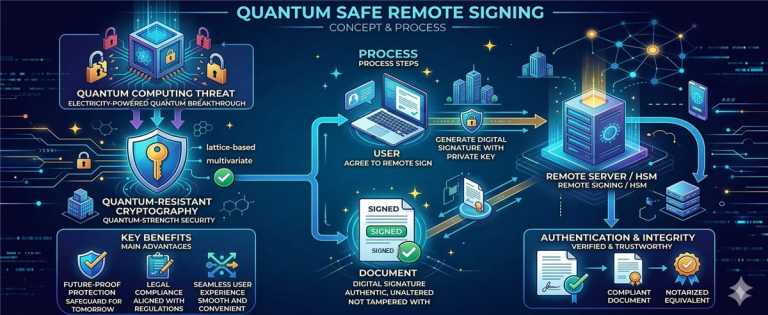
Post-quantum remote signing for long-term digital trust

Quantum-Safe Remote Signing Ecosystem Mobile-ID positions a Quantum-Safe Remote Signing ecosystem for contracts, digital dossiers, enterprise eSeals, and evidentiary records—designed for organizations that require legal validity, auditability, and long-term retention.…

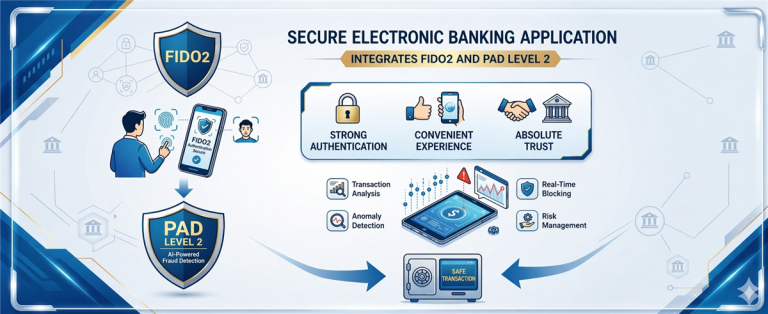
Application of FIDO2 and PAD Level 2 for Digital Banking

Digital Trust • Banking Security A practical approach to strengthening authentication, preventing biometric spoofing, and aligning with evolving compliance requirements for Mobile Banking, Internet Banking, and high-risk user journeys. Executive…

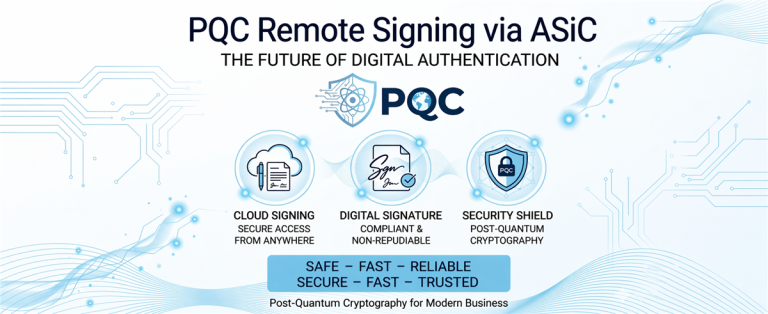
Application of PQC Remote Signing via ASiC Container

Quantum-Safe Signing · Digital Dossier · ASiC-CAdES A practical approach to building high-trust electronic dossiers, preserving digital evidence, enabling multi-layer authentication, and laying the foundation for transitioning from traditional digital…

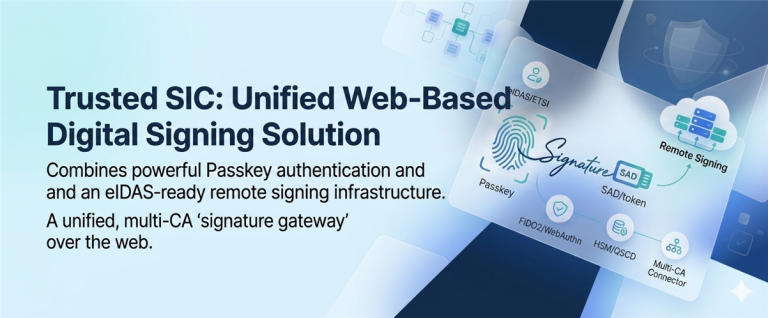
Trusted SIC – Unifying Remote Signing and Passkey for a standardized, secure and multi-CA digital signature experience.

Digital Trust · Remote Signing · Passkey Trusted SIC is positioned as a unified web-based digital signing interaction layer, integrating FIDO2/WebAuthn/SPC authentication with remote signing infrastructure and a multi-CA model.…

This website uses cookies

By clicking "Accept all", you agree to the storing of cookies on your device to enhance site navigation, analyze site usage, and assist in our marketing efforts.

Custom cookie preferences

These cookies are required for the website to function properly. They do not collect data for advertising purposes and cannot be disabled, as this would break the site's basic functionality.

Always active

These cookies remember your choices and settings to provide a more personalized experience, such as your selected language, dark/light theme, font size, region, or other customizations.

These cookies help us understand how visitors interact with the site. All data is fully anonymized and used solely to improve site performance, loading speed, and content quality—no personal identification.

These cookies enable us to show you more relevant ads on our site and across other platforms. They anonymously track your browsing behavior and prevent the same ad from appearing repeatedly.