



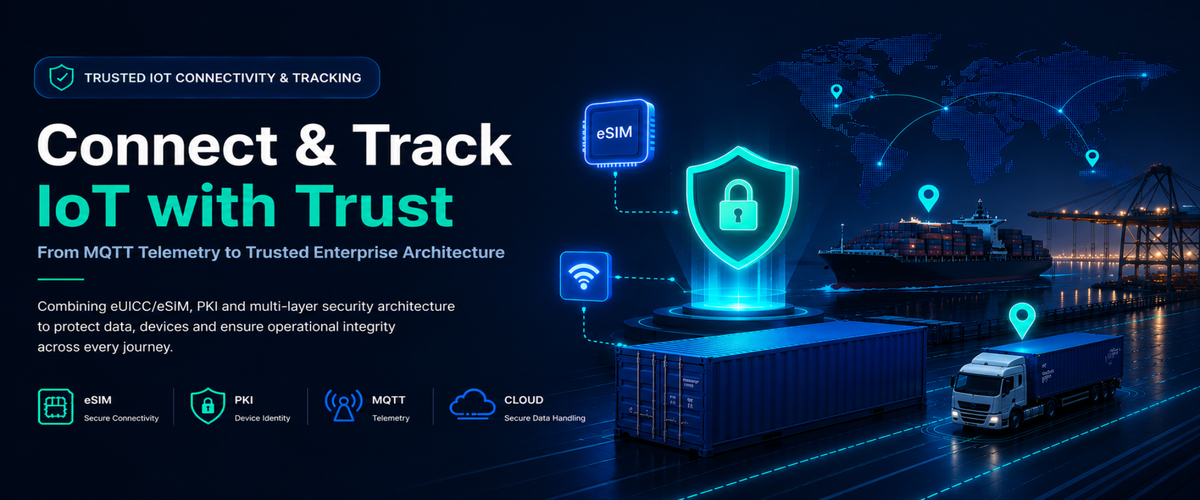
When logistics, cold-chain and container tracking enter real operational environments, customer requirements go beyond “the device can send data.” What they need is an architecture that clearly identifies which device is transmitting, where the keys reside, how they can be revoked, who may publish to which namespace, and how to elevate operational telemetry into data trustworthy enough for compliance, auditing and dispute resolution.
This article presents a Trusted IoT Connectivity & Tracking model built on eUICC/eSIM, GSMA IoT SAFE, EMQX and Mobile-ID PKI, through the lens of system architecture, security control layers, operational models and practical go-to-market strategy.
Four Value Layers of the Model
The solution is designed not as a standalone tracking device, but as a service stack with built-in trust capabilities.
Why Traditional Container Tracking Falls Short for the Enterprise Market
A commodity tracking system typically answers “where” and “when” well. But in environments with higher requirements — high-value cargo, cold-chain, seal monitoring, or multi-party supply chain operations — the market begins to ask more: where did the data come from, could the device have been cloned, can credentials be revoked, is there evidence for cross-referencing?
Weaknesses at the Device Layer
- Secret keys or access tokens typically reside in firmware, NVRAM or the file system.
- Device replacement or maintenance processes risk exposing identities and shared secrets.
- Edge devices are rarely designed to function as genuine trust anchors.
Weaknesses at the Connectivity Layer
- Many systems still rely on username/password or shared secrets for MQTT.
- Topic namespaces are not standardized early enough, leading to fragmented access control that is hard to scale.
- Brokers handle connections well but lack the context to map tenants, assets and policies.
Weaknesses at the Operational Layer
- Certificate revocation, rotation and device isolation are not built into standard operational workflows.
- Pilots run successfully, but production environments lack observability, audit logs and clear accountability.
- Customers buy devices, but cannot buy a trusted managed service with a service-level agreement.
Layered Architecture for Trusted IoT Connectivity & Tracking
The architecture is organized into 4 main layers: edge, message plane, trust plane and application plane. This layering helps Mobile-ID standardize the role of each component, while opening the door to multiple deployment forms: battery-only tracking devices, industrial gateways, cold-chain data loggers or multi-tenant managed services.
Device / Edge Layer
Connectivity / Message Plane Layer
Trust / Trust Plane Layer
Application / Application Plane Layer
Drilling into the Technical Points That Determine Success or Failure
1. Device Identity Cannot Be Just a Serial Number
A serial number or IMEI/EID provides only static identification. In production environments, the system needs a cryptographic identity that can be used to authenticate connections, enforce access control and enable lifecycle management. That is why each device should have its own client certificate or a device-class certificate under strict control.
The registry needs to store not only serial numbers and asset IDs, but also certificate fingerprints, tenant ownership, firmware version, onboarding status and policy groups so that both the backend and EMQX speak the same language.
2. Root of Trust Should Be Anchored at the SIM/eSIM or Secure Element Layer
If secret keys live in firmware, cloning a memory image or unauthorized debugging can collapse the entire trust model. eUICC/eSIM aligned with IoT SAFE allows the SIM to act as a cryptographic secure vault where secret keys never need to be exported to the application environment.
In the early phase, if the hardware partner does not yet fully support IoT SAFE, the system can follow a transitional model using a secure element or equivalent TPM/SE. However, the long-term roadmap should aim for a trust anchor directly at the SIM/eSIM layer, as this is the layer most naturally aligned with M2M ecosystems and eUICC profile management.
3. The MQTT Broker Must Be Treated as a Message Plane, Not Just a Data Ingestion Point
EMQX is not merely a data receiver. It is the central connectivity plane of the entire system, where authentication, tenant separation, policy enforcement and event forwarding to downstream services all take place. As such, how listeners, ACLs, namespaces and integration pipelines are designed directly impacts scalability.
A common mistake is pushing too much tenant logic to the downstream application. A more sustainable approach is to let the message plane understand tenant identity as early as possible through certificate mapping and a policy store.
4. A Good Pilot Must Measure Both Battery Drain and Lifecycle Latency
For battery-powered devices, every cryptographic operation, reconnection and retransmission consumes energy. A pilot therefore cannot only measure “connected successfully.” It must also measure connection handshake latency, reconnection frequency, payload size, radio utilization and the impact of certificate renewal/revocation on battery life.
At the service level, key metrics also include the time to onboard a new device, how quickly a certificate revocation takes effect, the data delivery success rate after network loss, and the mean time to recovery from a policy or certificate incident.
An Example Topic Namespace for a Multi-tenant Environment
The topic model is a component often underestimated in the early stages, yet it determines the ability to enforce access control, isolate customers, structure command channels and scale analytics downstream.
tenant/{tenantId}/device/{deviceId}/telemetry
tenant/{tenantId}/device/{deviceId}/event/door
tenant/{tenantId}/device/{deviceId}/event/shock
tenant/{tenantId}/device/{deviceId}/event/geofence
tenant/{tenantId}/device/{deviceId}/event/tamper
tenant/{tenantId}/device/{deviceId}/status/heartbeat
tenant/{tenantId}/device/{deviceId}/status/fw
tenant/{tenantId}/device/{deviceId}/cmd/downlink
tenant/{tenantId}/device/{deviceId}/audit/security
Periodic Data Channel
Contains periodic data such as location, battery, temperature, humidity, network signal, seal status or sensor state.
Event Channel
Reserved for anomalous or high-alert-value events: door open, shock, geofence breach, physical tampering, power loss.
Command / Audit Channel
Used for OTA commands, remote configuration, policy rotation and audit logs related to security operations.
Security Hardening Layers Required Before Commercialization
When transitioning from pilot to production, the system is no longer evaluated solely by the number of devices online. It is evaluated by its fault tolerance, incident isolation capability, audit transparency and how proactively it handles compromised devices.
Controlled Device Provisioning and Onboarding
Devices must be brought into the system through a consistent process: factory registration, warehouse preparation or field onboarding. Every onboarding path must be tamper-resistant to prevent an unverified device from autonomously requesting a certificate to join the system.
Mutual TLS and Per-device Certificates
Where feasible, per-device certificates should be preferred. This enables precise revocation, localized isolation of a compromised device and ensures audit logs remain operationally meaningful.
Tenant- and Class-based ACLs
A device should only be able to publish into its own tenant’s namespace. If a command channel exists, downlink commands must also be tightly scoped to the device or policy group, preventing any client from issuing commands outside its authorized scope.
Application-layer Payload Encryption for Sensitive Events
For events involving seal breaches, manifest hashes or cold-chain evidence, application-layer payload encryption reduces the trust that needs to be placed in the broker and intermediate processing pipelines.
System Observability and Incident Response Procedures
Production environments cannot be operated without dashboards, alerting, log correlation and incident response procedures. Runbooks are needed for mass reconnection storms, bulk certificate expiry, devices publishing to wrong topics, cloned devices and failed OTA rollbacks.
Isolation and Revocation in Practice
Revocation should not exist only on paper. The system must be able to demonstrate that a suspected compromised device can be blocked quickly, moved to an isolated state and removed from the operational flow with controlled impact.
| Category | Recommended Minimum Level | Advanced Level | Business Significance |
|---|---|---|---|
| Device | Unique device identity + secure storage | eUICC/eSIM aligned with IoT SAFE | Reduces device cloning risk and lowers key exposure risk |
| Connectivity | MQTTS + standard policy | mTLS + per-device certificate | Strengthens access control and enables precise certificate revocation |
| Message Plane | Topic-based access control | Tenant-aware policy + dynamic registry mapping | Easier multi-tenant scaling and reduced operational errors |
| Data | Data integrity over the transport channel | Payload encryption for sensitive streams | Supports regulatory compliance and dispute evidence |
| Lifecycle | Issuance / renewal / revocation | Isolation / audit / automation / SLA | Transforms a technical problem into a managed service |
Organizing Deployment as a Service, Not as a Batch of Devices
Phase A – Architecture & Bill of Materials Validation
- Lock in modem, device and firmware/SDK expansion capability choices.
- Define the provisioning approach and certificate issuance model.
- Standardize the topic model, access control matrix, and DN/SAN naming conventions in certificates.
- Assess field constraints: battery, environment, transmission intervals, network coverage.
Phase B – Controlled Pilot Deployment
- Run a pilot with 20–50 devices, 1 real tenant and 1 use case with a clearly defined pain point.
- Measure connection success rate, delivery latency, reconnection behavior, battery consumption.
- Validate certificate revocation, renewal, access control enforcement and data routing.
- Review the field support and device replacement model.
Phase C – Production System Hardening
- EMQX HA, registry redundancy, backups, system observability and SIEM integration.
- Incident response procedures, operations dashboard, permission model and audit reporting.
- Standardize new customer onboarding and bulk device provisioning workflows.
- Package SLAs, support timeframes and change management processes.
Phase D – Commercial Packaging
- Define service tiers: Standard, Secure, Trusted, Evidence-grade.
- Design pricing by device, tenant, retention period, event volume and SLA tier.
- Build a partner toolkit for OEMs, carriers, system integrators and large enterprises.
- Expand to adjacent use cases such as cold-chain assurance and secure fleet management.
Customer Development Direction for Bringing the Solution to Market
For successful commercialization, Mobile-ID should sell “trusted operational outcomes” rather than hardware alone. Each customer segment must be approached through their real pain points, operational metrics and the level of trust they genuinely care about.
Container & Logistics Operators
Pain points: loss of journey visibility, unauthorized seal breaks, disputes over cargo condition.
Message: seeing the container is not enough; you need to prove trusted events occurred.
Cold Chain / Pharma / Food
Pain points: temperature excursions, out-of-process door openings, need for end-to-end evidence across the journey.
Message: trusted data reduces disputes and supports compliance documentation.
High-value Assets / Secure Fleet
Pain points: sensitive routes, high-value cargo, risk of device spoofing or substitution.
Message: a trust architecture reduces device impersonation risk and increases operational control.
OEMs / Carriers / System Integrators
Pain points: hardware or connectivity available but lacking a trust layer and lifecycle management.
Message: Mobile-ID can be the trust enablement layer or managed PKI layer for your IoT ecosystem.
| Customer Segment | Lead Use Case | Suitable Service Tier | Decision Maker |
|---|---|---|---|
| Logistics / container transport | Tracking + seal + geofencing + shock | Secure or Trusted Tracking tier | COO, Logistics Director, CIO |
| Cold chain | Temperature / humidity / door / evidence chain | Trusted or Evidence-grade tier | Operations, Quality, Compliance |
| High-value assets | Tamper detection + route integrity + command control | Trusted Tracking tier | CISO, Operations, Risk Management |
| OEM / Carrier / System Integrator | White-label trust layer, managed PKI, secure MQTT device onboarding | Partner tier | Partnerships, Product, CTO |
Product and Service Roadmap for the Next 12–18 Months
Wave 1 – Secure MQTT Foundation
- EMQX Cluster, PKI, registry, basic operations dashboard.
- Per-device X.509, mTLS, policy model and topic naming conventions.
- Pilot tracker/gateway devices with GPS, sensor events, alerts and webhooks.
- High-level design documents, APIs, standard operating procedures and operational checklists.
Wave 2 – Trusted Device Identity
- Deeper integration with eUICC/eSIM or an equivalent secure element.
- Lifecycle automation: provisioning, renewal, revocation, isolation.
- Expansion to cold chain, command channels and multi-tenant admin portal.
- Packaging of service tiers: Standard / Secure / Trusted Tracking.
Wave 3 – Evidence & Ecosystem Expansion
- Application-layer payload encryption for sensitive events.
- Evidence service for compliance workflows and dispute resolution.
- Partner integration toolkit for OEMs, carriers and system integrators.
- Positioning the Trusted IoT Connectivity platform as a new Mobile-ID trust service.
Conclusion
Trusted IoT Connectivity & Tracking is a very natural extension for Mobile-ID from its PKI foundation, certificate lifecycle management and existing trust services. When the right hardware, eUICC/eSIM, EMQX message plane and a standardized lifecycle model are properly combined, Mobile-ID can position itself not merely as a tracking service provider, but as a provider of the trusted architecture layer for enterprise IoT operations.
The commercial value of this solution lies in the fact that customers do not have to buy a collection of disparate technologies. They buy a trusted service: controlled device onboarding, secure connectivity, devices with clear identities, verifiable data and scalable operations.

Community Discussion
Comments
Comments