



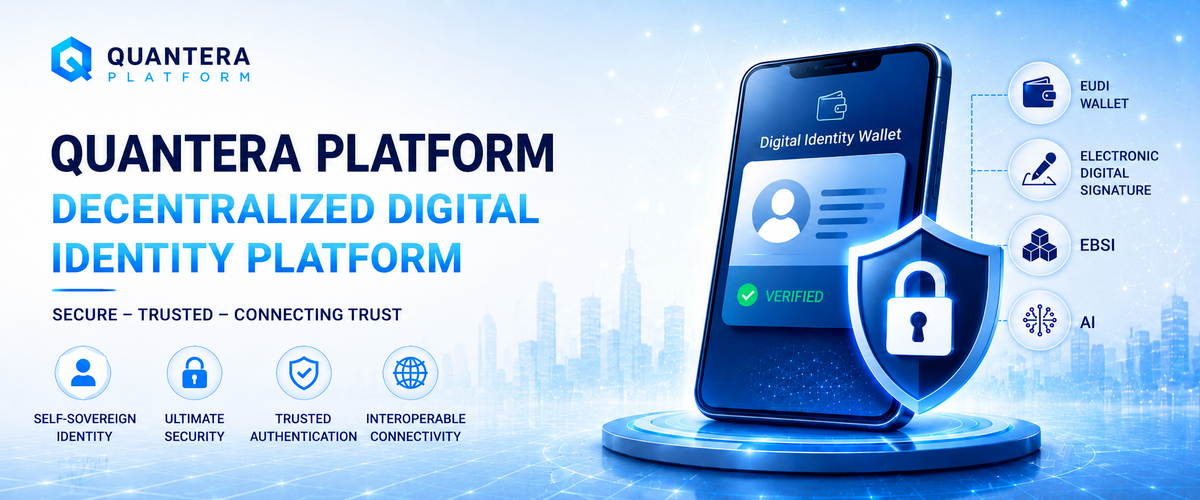
Quantera is positioned as a Digital Trust Infrastructure platform for enterprises, governments, and digital service ecosystems: where users control their identity, issuing organisations provide verifiable digital credentials, and relying parties can trust data without depending on a centralised identity store.
From identity wallet to scalable digital trust infrastructure
Quantera is more than a credential wallet. The platform aims at a complete ecosystem for issuing, storing, presenting, verifying, electronic signing, trust governance, and AI-powered risk analysis.
User-Centric Identity
Users retain control over their DID, credentials, and attribute sharing. Instead of submitting a full identity profile, users can share only the specific attributes required — for example “of legal age”, “KYC-verified”, “legal representative”, or “authorised to sign”.
DIDVCSelective DisclosureOrganisational Trust
Quantera inherits the EBSI philosophy for trust registries: a list of trusted issuers, credential schemas, revocation status, and verification policies. This allows organisations not just to “receive data”, but also to know who issued it and whether it remains valid.
Trust RegistryIssuer Trust LevelRevocationTransaction-Level Trust
By combining QES, blockchain signatures, and audit logs, Quantera can extend from identity verification to legally binding transactions: contract signing, document approval, authority proof, transaction trail, and post-signing verification.
QESAudit LogBlockchain SignatureMulti-layer architecture for decentralised digital identity
The Quantera platform is designed using a layered model to clearly separate the roles of users, applications, identity/credentials, blockchain, digital signatures, and external system integrations.
The differentiator: not just SSI, but a trust platform for digital transactions
Traditional SSI focuses on user control over credentials. Quantera extends SSI into an operationally viable enterprise platform by combining an API gateway, IAM, digital signatures, off-chain storage, a trust registry, and a message bus for transaction processing.
In this architecture, Hyperledger Fabric is not a store for all personal data. Fabric acts as a verifiable data registry for DIDs, registries, status, policies, and audit events. Sensitive data or source documents are stored off-chain in MinIO, encrypted and governed by metadata in MariaDB.
The correct Quantera design principle is: “on-chain for trust, off-chain for privacy, wallet for user control, API gateway for enterprise integration”.
Technical Value Chain
1. Issuance: The issuer issues a VC against a trusted schema, signs the credential, and records its status in the registry.
2. Custody: The wallet stores the DID/VC, manages consent, and allows the user to present credentials in the appropriate context.
3. Presentation: The user generates a VP, optionally with selective disclosure or ZKP-based attribute proof.
4. Verification: The verifier checks the signature, issuer trust level, schema, revocation status, and policy.
5. Transaction: If a legal binding is required, the system triggers QES/remote signing and stores an audit log.
Quantera bridges three standardisation axes into a single deployable platform
| Platform Axis | Technical Role | How Quantera Realises It | Application Value |
|---|---|---|---|
| EUDI Wallet | Identity wallet, attribute presentation, user consent, PID/attestation, remote/proximity interaction. | Quantera Wallet manages DID, VC, VP, consent, and integrates digital signing/QES when a credential needs to become a legally binding transaction. | European-standard user experience: hold the wallet, select data, confirm, present. |
| SSI | DID, VC, VP, DIDComm, selective disclosure, holder-controlled. | did:quantera, walt.id SSI Kit, Universal Resolver, BBS+/ZKP, OIDC4VC, and APIs for issuers/verifiers. | Reduced reliance on centralised identity systems; greater personal data control. |
| EBSI-inspired Trust | Trust registry, issuer list, schemas, revocation, cross-border trust governance. | Fabric chaincode manages registry, schemas, credential status, and verification policies. | Organisations can verify the origin and validity of data, not just read it. |
| QES & Remote Signing | Legal binding, electronic/digital signature, CA/HSM, transaction authorisation. | WSO2 connects to CA, HSM, and signing systems; the wallet can trigger a signing workflow from a credential context. | Turns verified identity into legally valid action: contract signing, approval, authorisation. |
| AI Trust Layer | Fraud detection, biometric verification, policy advisory, risk scoring, assistant. | AI APIs deployed on Wildfly, using Kafka for async processing, MinIO/MariaDB for training data and metadata. | Automates verification, reduces fraud risk, and supports operations at scale. |
Practical applications of Quantera in enterprise, finance, education, and digital government
Banking & Finance
Quantera can support KYC/KYB, legal representative verification, transaction authentication, digital account opening, credit limit issuance, loan contract signing, and enterprise authorisation management.
Example: a customer presents VCs confirming “identity verified”, “company director”, “authorised to sign”, then triggers QES to sign the credit documentation.
Digital Degrees & Professional Certifications
Universities, training centres, or licensing bodies issue digital degrees as VCs. Employers directly verify the signature, schema, issuer trust level, and revocation status.
Reduces paperwork, curbs credential fraud, and enables cross-border verification.
Digital Government & Public Services
Citizens can hold credentials for residency, licences, professional certifications, or service entitlements. Government service portals request only the specific attributes they need.
Strengthens privacy-by-design and reduces the risk of storing excess personal data.
Electronic Contracts & Contract Lifecycle Management
Quantera integrates with the digital signing ecosystem to verify the signer’s identity, role, authority, and legal status before a signing transaction is initiated.
Suitable for employment contracts, sale and purchase agreements, credit contracts, and insurance policies.
Access Control & Kiosk
Credentials can be used for entry/exit control, visitor registration, event check-in, self-service kiosks, or counter-based verification using the proximity presentation model.
No need to expose full personal details when only access rights need to be proven.
Cross-Border Digital Trust
Quantera is oriented towards EBSI/EUDI compatibility to prepare for cross-border scenarios: international study, overseas employment, logistics, eID, and business certification.
Supports expansion beyond Vietnam’s borders with a trust registry model and credential interoperability.
Sample business flow: from credential issuance to transaction signing
Registration & DID Creation
The user registers with Quantera Wallet, creates a did:quantera, and sets up an authentication method. The issuing organisation is recorded in the trust registry.
Credential Issuance
The issuer verifies the applicant’s documents, issues a VC conforming to the standard schema, signs the credential with the organisation’s key, and records the credential status in the Fabric registry.
Wallet Storage & Consent
The wallet stores the credential, displays attributes, and allows the user to manage the lifecycle — revoking sharing or presenting in the appropriate context.
Verifier Request
The enterprise/verifier sends a verification request via OIDC4VC or a proximity flow. The request clearly states the purpose, required attributes, and data-handling policy.
Verifiable Presentation
The user reviews the request. The wallet generates a VP, optionally with selective disclosure or ZKP, and submits it to the verifier.
Trust Validation
The verifier checks the signature, DID, issuer, schema, revocation, registry, and policy. If the transaction requires legal weight, the workflow triggers QES/remote signing.
Audit & Analytics
Business events are recorded in the audit log, fed into Kafka for asynchronous processing, and used for risk monitoring, operational analytics, and the AI assistant.
AI in Quantera: from operational support to fraud prevention
AI does not replace the trust framework — it augments intelligent operational capability. AI models can analyse anomalous behaviour, detect fraud, support credential reconciliation, provide compliance advisory, and optimise signing workflows.
In an enterprise environment, the AI Assistant can help users ask: “Which credentials do I need to open a business account?”, “Is this credential still valid?”, “Why was my application rejected?”, or “Who is authorised to sign this contract?”.
Security & Compliance by Design
Quantera should be deployed with the following principles: data minimisation, off-chain encryption, separation of metadata from sensitive data, explicit consent, transparent audit trails, and explainability when AI makes recommendations.
This is a critical requirement for the platform to be suitable for banking, insurance, government, and high legal-risk service environments.
Proposed deployment roadmap for Quantera
| Phase | Objective | Technical Scope | Expected Outcomes |
|---|---|---|---|
| Phase 1: Foundation 3–6 months |
Build the core trust infrastructure. | Fabric network, did:quantera, basic chaincode, walt.id customisation, MinIO/MariaDB, WSO2 gateway. | Testing environment for DID, VC issuance, VC verification, and basic registry. |
| Phase 2: Pilot 3–6 months |
Test real-world scenarios with issuers and verifiers. | Issuer portal, verifier portal, wallet interface, OIDC4VC, revocation, QES integration, audit log. | Pilot for digital degrees, enterprise KYC/KYB, or a digital signing workflow. |
|
Phase 3: Production Deployment 6–12 months |
Launch the production mainnet/private network. | Kubernetes, Fabric HA, observability, policy tools, advanced trust registry, EBSI compatibility. | Platform ready for banking, enterprise, and government use. |
| Phase 4: Scale-Out 12+ months |
Expand the ecosystem and AI capabilities. | Healthcare, financial, and government credentials, cross-border bridge, AI risk assessment tools, compliance assistant. | Quantera becomes a multi-sector integrable trust network. |
Quantera repositions the digital identity narrative: from “user authentication” to “verifying the trust of the entire transaction”.
As EUDI Wallet introduces a modern identity wallet model, SSI gives users control over their data, EBSI provides a registry/trust governance mindset, and QES creates legal value — Quantera has the foundation to become a strategic platform for high-trust digital services.
Community Discussion
Comments
Comments