



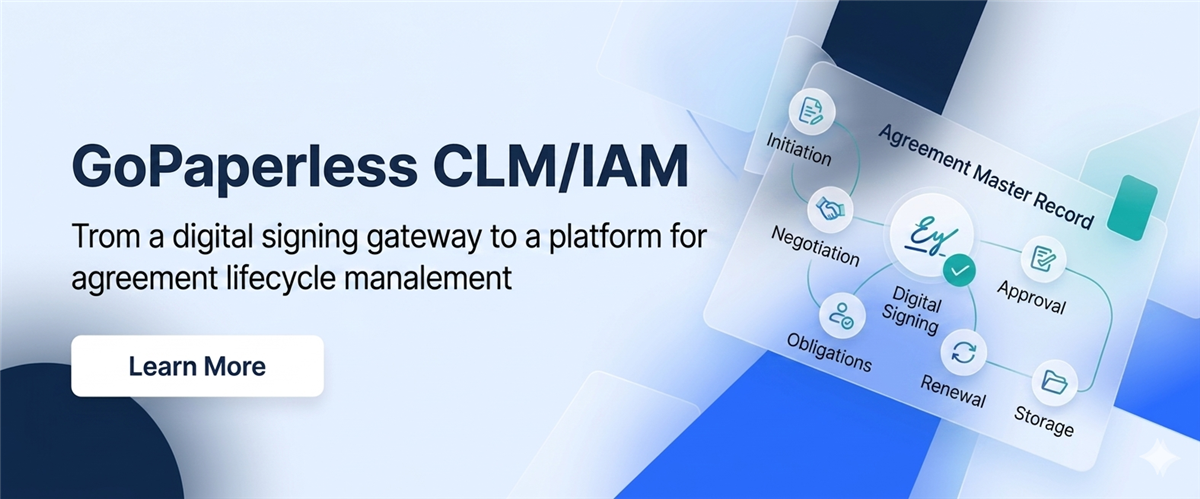
In many organizations, digital signatures only address the final “checkpoint” of a document. Greater value lies in controlling the entire journey of an agreement — from initiation, negotiation, approval, and digital signing to tracking obligations, renewals, amendments, and evidence archival.
That is why GoPaperless should evolve from a workflow portal with strong digital signing capabilities into a complete CLM/IAM platform, particularly suited for banks, large enterprises, and environments that demand high-level governance.
If digital signing is the “completion point,” then CLM/IAM is the “operating system” of the entire agreement. With this direction, GoPaperless not only ensures documents are signed through the correct process, but also helps organizations know precisely: which agreements are in effect, which clauses deviate from standards, which obligations are approaching their deadlines, and who is accountable for each subsequent action.
This upgrade is not a replacement for the current GoPaperless. On the contrary, it is a synergistic evolution: leveraging the existing workflow engine, template engine, remote signing, evidence report, role model, and integration capabilities to build a more complete agreement lifecycle governance layer on top.
What will GoPaperless be after the upgrade?
An agreement lifecycle platform that enables management of documents, approvals, digital signing, evidence storage, metadata, clauses, obligations, renewals, amendments, terminations, and executive reporting — all on a single platform.
Why Does the Market Need the Shift from E-Signature to CLM/IAM?
In many enterprises, contracts and agreements remain fragmented across emails, shared folders, CRM, LOS, ERP, or scattered document repositories. Once signed, organizations typically lose track of effective dates, notice deadlines, exception clauses, post-signing obligations, and renewal schedules.
For banks and regulated organizations, this gap is even wider: they need to quickly answer questions such as which records are still active, which are expiring soon, which clauses deviate from the standard template, which obligations are overdue, who is the business owner, and what evidence can be presented during an audit or dispute.
GoPaperless Already Has a Strong Foundation to Build On
The strength of this strategy is that GoPaperless is not starting from scratch. The current platform already contains many critical components to evolve into a more powerful CLM/IAM platform.
Workflow and Recipient Sequencing
Supports serial, parallel, and custom sequence flows, recipient roles, and document processing progress control.
Signing and Approval Capabilities
Supports local signing, server-side signing, and remote authorized signing with flexible authentication levels.
Evidence Report and Audit Baseline
A critical foundation for expanding toward lifecycle-wide evidence and dispute-ready traceability.
Template-driven Standardization
Well-suited for further development into legal playbooks, clause packs, and metadata presets per use case.
Enterprise Control Plane
Users, groups, branding, integrations, settings, and role models already lay the groundwork for deeper governance.
API & Event-friendly Orientation
Well-suited for connecting to CRM, core banking, LOS, DMS, ERP, procurement, notification, and BI systems.
From Workflow Portal to Agreement Lifecycle Platform
The core of the CLM/IAM upgrade is transforming each workflow package into an Agreement Master Record. From that point forward, a document is no longer just a signed file — it becomes a business entity with its own identity, metadata, lifecycle state, owner, counterparty, obligations, renewal schedule, amendment versions, and a linked evidence set.
| Aspect | Current GoPaperless | GoPaperless CLM/IAM |
|---|---|---|
| Managed Object | Documents and digital signing workflows | Agreement master record and the full agreement lifecycle |
| Status | Draft / In Progress / Completed | Draft, Negotiation, Approval, Awaiting Signature, Active, Pending Renewal, Amended, Terminated, Archived |
| Data | Fields and workflow information | Metadata, clause facts, parties, obligations, retention, legal hold, risk flags |
| Post-signing Value | File storage and evidence report | Obligation tracking, renewal reminders, amendment/termination flow initiation, portfolio analytics |
| Governance Perspective | Process governance | Agreement lifecycle, risk, and compliance governance |
CLM/IAM Capabilities Should Be Added in a Modular Approach
1. Agreement Repository
Creates a master record for each document set, storing metadata, lifecycle status, linked files, parties, effective date, expiry date, and relationship links.
2. Metadata & Taxonomy
Enables flexible schemas per use case: contract type, customer ID, vendor ID, branch, legal entity, jurisdiction, and risk class.
3. Lifecycle Management
Tracks the journey from draft through active, amendment, renewal, termination, and archival — rather than stopping at completion.
4. Clause Intelligence
Extracts key terms, compares against playbooks, detects non-standard clauses, and flags exceptions requiring approval.
5. Obligation Engine
Creates post-signing obligations, deadlines, reminders, escalations, and completion evidence to prevent “sign and forget.”
6. Policy & Exception Engine
Orchestrates deviations, threshold approvals, maker-checker, dual control, and policy-based routing logic.
7. Search & Analytics
Searches by metadata, full-text, counterparty, and lifecycle status — providing dashboards for expiry, overdue items, and cycle times.
8. Post-sign Orchestration
Triggers DMS, CRM, LOS, ERP, notification, or archival services immediately upon completion or downstream lifecycle events.
Why Is This Model Particularly Suited for Banks and Regulated Enterprises?
Banks do not simply need a digital signing tool. They need a control layer that ensures account opening records, credit documentation, vendor risk, policy acknowledgements, and board approvals are continuously tracked well beyond the point of signing. This is precisely where CLM/IAM creates real differentiation.
Bank-grade Governance
Role-based permissions, segregation of duties, retention policy, legal hold, immutable audit trails, and flexible on-prem/private cloud deployment.
Evidence-led Trust Model
GoPaperless is already strong in signing and workflow evidence; expanding into lifecycle evidence will significantly increase pre-sales value.
Counterparty 360
Links agreements to customers, vendors, cases, facilities, or deals — transforming the repository into a data store with full business context.
Operational Accountability
Know who owns each renewal, who must complete each obligation, who approves each deviation, and when risk events are triggered.
Target Architecture: Additive and Non-Disruptive to the Existing Core
The right strategy is not to build a separate product, but to add an IAM services layer on top of the GoPaperless core. This approach reduces product risk while maintaining time-to-market.
Experience Layer
Portal UI, embedded journeys, dashboard, inbox, partner-facing views, and admin experience for agreement-centric workflows.
GoPaperless Core
Document intake, workflow preparation, recipient management, signing services, evidence generation, and administration.
IAM Services Layer
Agreement service, metadata service, search indexing, clause engine, obligation engine, lifecycle engine, analytics, and AI assistant.
Integration & Data Layer
API gateway, webhook manager, event bus, object storage, metadata DB, search engine, audit log, BI mart, and archival controls.
Technical Principles to Maintain
A Sensible Implementation Roadmap for Rapid Commercialization
To avoid overly broad scope from the outset, GoPaperless should follow a productization strategy layered by capability.
Phase 1 – Foundation
Establish the Agreement Master Record, metadata schema framework, lifecycle states, a basic repository UI, search, and renewal alerts.
Phase 2 – Governance
Add obligation engine, amendment/termination flows, policy rules, counterparty linkage, workflow-to-record APIs, and event contracts.
Phase 3 – Bank-grade Hardening
Introduce exception routing, retention controls, advanced reporting, LOS/CIF connectors, enhanced approval frameworks, and deployment patterns tailored for banking environments.
Phase 4 – Intelligence
Develop clause extraction, playbook validation, natural-language search, AI-generated summaries, and risk indicators as part of a premium tier offering.
New Pre-Sales Messaging for GoPaperless
Old Message
GoPaperless helps enterprises digitize approval workflows and document signing.
New Message
GoPaperless with CLM/IAM helps enterprises and banks govern the entire agreement lifecycle — from creation, review, approval, and signing to obligations, renewals, amendments, repository governance, and analytics.
Suggested Packaging
IAM Standard
Repository, metadata, lifecycle states, search, and renewal alerts.
IAM Professional
Obligations, amendments, terminations, integration hooks, and dashboards.
IAM Enterprise
Policy rules, exception flows, counterparty 360, and advanced analytics.
IAM Bank-grade
Private deployment, high-assurance workflows, retention, enhanced audit capabilities, and an integration pack for regulated environments.
Conclusion
GoPaperless already has a product core well-suited for expansion into CLM/IAM. The priority is not to rebuild everything from scratch, but to reframe the product vision in an agreement-centric and lifecycle-centric direction.
By upgrading along this path, GoPaperless moves beyond the positioning of a standalone e-signature portal to become an agreement governance platform with operational depth, industry scalability, and a far stronger pre-sales narrative for enterprise and banking segments.
From Trusted Signing to Trusted Agreement Operations
This strategic evolution positions GoPaperless closer to a complete platform for digital trust, compliance, and lifecycle governance.

Community Discussion
Comments
Comments