



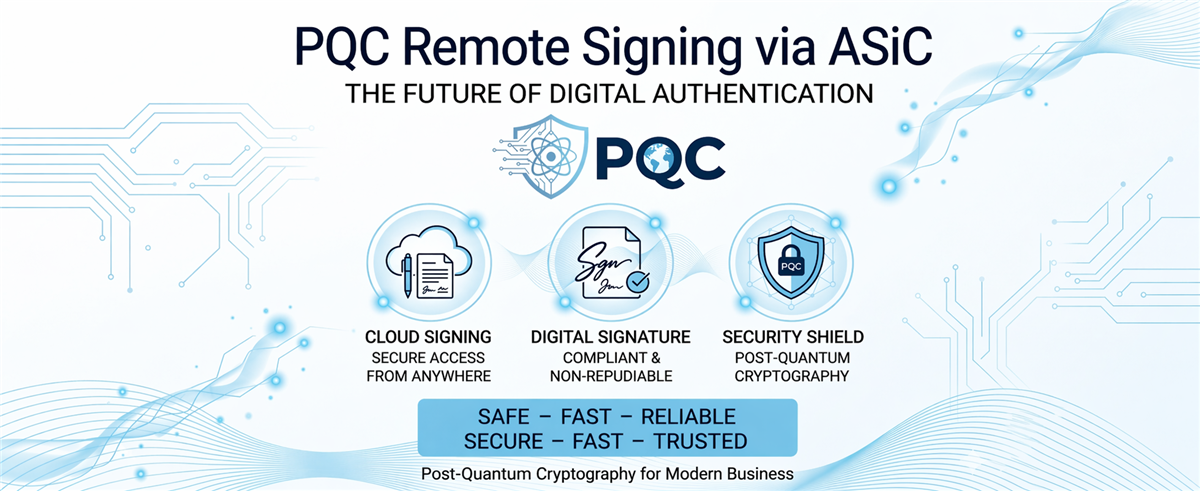
A practical approach to building high-trust electronic dossiers, preserving digital evidence, enabling multi-layer authentication, and laying the foundation for transitioning from traditional digital signatures to a quantum-safe model.
Why is the ASiC container an ideal entry point for PQC Remote Signing?
ASiC enables packaging multiple components into a unified electronic dossier: business documents, manifest, metadata, detached signatures, timestamps, validation reports, and long-term preservation data. When applying PQC to remote signing, the container structure reduces dependency on individual file format viewers while enabling dossier-centric management instead of file-centric.
This becomes especially important as the market transitions into the post-quantum era: systems can fully control the lifecycle of dossier creation, signing, validation, evidence storage, and reporting without waiting for widespread viewer support.
Typical application architecture
A suitable deployment model for Mobile-ID can be structured into four tightly integrated layers, balancing user experience and backend control.
Portal & Workflow
Intake documents, initiate dossiers, orchestrate signing flows, manage signers, display workflow status, and export complete packages.
ASiC Packaging Layer
Standardizes container structure, manifest, metadata, detached signatures, timestamps, validation artifacts, and dossier manifest.
PQC Remote Signing Core
Orchestrates remote keys, triggers signing sessions, executes ML-DSA signing profiles, applies policies, and integrates secure signing backends.
Validation & Evidence
Analyzes containers, verifies signatures and timestamps, evaluates policies, generates evidence reports, and supports audit and archival use cases.
Core values of this model
1. Electronic records treated as complete dossiers
In many business processes, a transaction involves multiple documents, multiple participants, and multiple layers of evidence. ASiC containers align much better with this reality than isolated file-based signing.
2. Validation goes beyond pass/fail
With Portal and Agent, validation can be presented across layers: container validity, signature profile compliance, timestamp validity, applied policies, and any interoperability limitations that need to be flagged.
3. Stronger evidence integrity
This model is particularly suitable for environments requiring audit readiness, dispute handling, and long-term retention. With each transaction packaged as a complete evidence bundle, reconciliation and verification become more systematic.
Early adoption use cases
| Sector | Use cases | Why prioritize |
|---|---|---|
| Banking & finance | Credit dossiers, reconciliation packages, enterprise eSeal, batch signing, audit files | High volume, strict audit requirements, strong need for evidence and governance |
| Government & public sector | Administrative records, inter-agency documents, dossier transfers | Long lifecycle, strict archival requirements, need for clear accountability |
| Insurance & legal | Claim packages, review dossiers, compliance packs, dispute dossiers | Requires preserved evidence and multi-layer validation across lifecycle |
| Regulated enterprises | Evidence sealing, dossier validation portal, archive-ready exports | Supports gradual transition to quantum-safe for high-value records |
Three PQC transition profiles
Instead of a big-bang migration, organizations can adopt phased approaches to reduce risk and accelerate commercialization.
- Profile A – PQC-only in controlled environments: suitable for PoC, internal pilots, or closed partner ecosystems.
- Profile B – Hybrid evidence: maintains quantum-safe evidence while adding compatibility layers for transition.
- Profile C – Dual validation: provides both traditional and quantum-safe validation paths within the same workflow.
Suggested development roadmap for Mobile-ID
Phase 1 – Core capability build
Complete ASiC-CAdES packaging, validator core, ML-DSA signing backend, basic evidence reporting, and Agent capable of opening, inspecting, and validating packages.
Phase 2 – Controlled enterprise pilot
Focus on workflow templates, admin dashboards, audit reporting, role-based orchestration, and pilot deployments for high-value dossiers.
Phase 3 – Commercial standardization
Package solution bundles, harden APIs, build partner integration documentation, support models, installation kits, and policy handbooks.
Phase 4 – Ecosystem expansion
Develop dossier exchange, archive services, industry-specific packages, and broader integrations with existing digital ecosystems.
Conclusion
The PQC Remote Signing with ASiC container approach is highly practical as it simultaneously addresses three key challenges: post-quantum digital signing, dossier-centric record management, and preservation of digital evidence for high-value processes.
For Mobile-ID, this is not just about a new signing algorithm, but an opportunity to position a quantum-safe digital trust platform that includes remote signing, validation, evidence integrity, enterprise eSeal, and long-term archival-ready digital dossiers.
Community Discussion
Comments
Comments